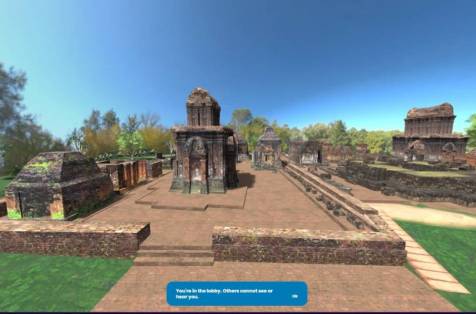

Tower K was described in the early 20th century as a gate tower, a 12th century architectural style, with a three-headed Brahmi statue hanging on the north wall. K Tower is a ruin located quietly in a corner of the forest, close to the starting point of modern people when they want to approach the monument, but almost no one knows and if they know, they don't come because there is no way. . Tower K has two doors, east and west, the entire roof has collapsed, all the bricks have poured into the heart of the tower. Climb to the top of this pile of bricks and look up at the two walls to see traces like mortar running down from the edge. of two bricks, the two walls of the north and south sides were gradually forced to fall outward. After clearing the vegetation, the K tower looked like two arms raised to the sky calling for help. The statue hanging on the north wall fell down. brought back to hang on the wall of tower D1 after D1 was restored. Just talking to each other like that, understanding like that, but there was no archaeological exploration because during that period there was still too much work to be done on the ground.
In 2017, Indian experts restored group K. Before the restoration, they took archaeological steps to regain the original ground, from which two rows of low walls running parallel towards areas E and F were revealed. . At this time, tower K was determined not only to be a gate but also to have two walls of the path. Archeology by Vietnamese scientists in 2024 continued to reveal two low walls running parallel, the two limits of the road that someone calls: The Royal Road.
Tower K is the gate tower. From here, one can faintly make out the silhouettes of the procession of people performing the ceremony. We don't know whether they are from the capital or somewhere else, but within a narrow range we know where they gather and we also know that their journey to get to the gathering place is not easy. The temple area is located in the heart of the valley, surrounded by mountains. How did the group come to Mỹ Sơn? Hills and forests make it impossible for vehicles to move, nor for horses. The aristocratic caravan followed each other, they actually walked on their own feet and did not ask others to carry them. They know that spiritual belief can only come from one's own practice. To cross this road, the gloomy thoughts of everyday life become heavy and hold my steps tight. The different plans of different noble factions fell gradually on the slopes. They left their weapons to kill each other outside the valley, the black and white are no longer there, but are only living beings looking for peace in the spiritual world.
Through the gate tower. Going down the steps is setting foot on the road. How will people walk on this road? We are often used to seeing rich people or powerful people coming to temples and pagodas with luxury cars and branded shoes. They drive into the temple grounds, proudly clicking their heels on the temple grounds, going all the way to the place, taking off their shoes. shoes for the entourage to keep before entering the ceremony. Arriving at Mỹ Sơn, passing through the gate tower, people no longer have the strength and power, no parasols, no hammocks to carry, with the bare feet of monks practicing the Dharma Dau Da, they quietly walk, their footsteps The ceiling is in direct contact with hot and cold sand, realizing that physical suffering can release a spiritual blockage. Thousands of years ago, Buddha in the East and Socrates in the West also practiced like this. on the warm and cold roads of the human world.
The road from the K tower to the temple area is only a short part of the harshest ascetic practice of the Brahmins. There is no reason why the ruling aristocrats would break the rule of law to leisurely lie in hammocks into the dead of night. temple foot. A few hundred meters of walking with bare feet, minimizing material needs, bare head without a canopy, knowing how to accept what is, is enough as a lesson for the ruling aristocrats to feel the pain. People's hardships when in direct contact with life, from there, distracting thoughts also become less dull. They walk like that with a true, moral, and strong soul. They move towards the divine realm with every step they take.
Where does the road to the gods in Mỹ Sơn go? Mỹ Sơn is not a temple but a system of temples located in different areas. Is it possible that the road from tower K to areas E and F has a stop, which opens up different directions: Direct direction to temple E1, direction separating to group G, group A, group B, C, D , group L and also group H? If that's true, there's still a lot of work to do, and the more I do it, the more curious I become, making work more and more exciting every day.
Directions - That is the story of the past in the imagination of people in the present day, a little imagination is needed to make the sacred space of Mỹ Sơn more vivid, and the present day pedestrians feel less tired. the harshness of the afternoon sun.
No longer imagining, now follow the group straight into area E. The first building the group approaches is E3, E3 is identified as Mandapa which means house of meditation, here the group stops, can They will sit down to meditate, reflect on the work they do, focus on themselves and the tasks at hand, stabilize their emotions, and determine for the last time whether they truly have enough intention to reach the gods.
Tower E2- Again identified as the gate tower, located immediately behind Mandapa E3. So, after stopping at E3 for a while, some people will continue through E2 and then worship in front of E1 temple, while others will still sit with lingering insecurities in their hearts. E2 is a gate, through which people can find the way to Mount Meru.
Tower K is a gate tower, through it people can access the sacred realm, the vast heaven, God is at the top of the legendary Meru mountain, people must continue to study and practice. Study until the final level of practice and then step through the second gate to the foot of the mountain where the gods reside. Here the sacred sound “OM” brings the prayer to the top of the mountain.
Identifying the K tower as a gate tower helps modern people imagine a section of practice of people entering Mỹ Sơn a thousand years ago, this section of the road was only for those who performed the ceremony, and in that line there may have been people. We should if there is a rainy day or a scorching noon when we go to Mỹ Sơn, don't care about external influences, without them we will feel as light as the footsteps of a monk walking.
Lê Xuân Tiến
17 Tháng 6,2024